Friday, July 15, 2011

a few pictures

stories to follow.
Our plane in Chicago, getting ready to take off. 9 across is too big!
 Rachel, plus the view from our balcony.
this is where we're staying. Its a comfortable spot, and we're glad Aimee set us up here.

Thursday, July 14, 2011

29 hours later, or are we there yet

Thursday, July 14th, 2011
Hello friends,
we have arrived safely in India, and I am ensconced on the porch of the International Guest House at Madras Christian College, our place of residence while we are here in Chennai.
Its about noon, we're waiting for Aimee, Rachel's sister in law to return from her placement before getting lunch and heading into the city proper for an afternoon of sights and shopping (Rachel is ready to dress more like a local).
Before my reflections on travel, a note. This is going to serve as an all-purpose diary for us-a combination of Voth family trip journal, a chance to update friends and family, an a place to reflect on any of the various cultural experiences we have, and anything else we want to throw in. Thus, fair warning, I feel no obligation towards subject verb agreement, or traditional concepts of narrative flow. This will be primarily for us, and our own enjoyment.
Anyway, first thoughts.
India is a long way away. It took us about 29 hrs. door to door to arrive at our current location, 15 hours of which were on the plane from Chicago to Delhi, squashed in the middle of the 5 across middle row, fighting for armrest space with strangers. It is not a good recipe to arrive rested and rejuvenated, though the novelty of playing tetris on a 777 did distract me for quite some time, and Indian food on an airline is a delightful treat.
Customs in Delhi were surprisingly non-anxious, they needed our word that we weren't smuggling anything illicit or dangerous, but there was no search. I presume they were content that anything Americans let on their planes is OK to allow in India. The men with big guns generally smiled and were helpful. At customs, they did need an address for our location in India, but "International Guest House, Madras Christian College, Chennai" was sufficient, so it seemed largely a formality.
The Delhi airport is nice (apparently, #4 in the world, according to someone), huge, and pretty quiet at 6:30 at night-the chaos of India had to wait until we arrived in Chennai, where there was ample chaos for everyone, from the busy baggage claim, the hundreds of people waiting to pick up travelers at the airport, and of course, the process of getting out of the parking lot.
It is of course cliche, but the experience of watching traffic flow completely naturally, with no concern for street signs, lane markers, pedestrians, or right of way takes some getting used to. As far as I can tell the only rules are stick to your side of the street (left) and don't hit anyone. It, I think, will continually flabbergast me that more cars aren't scraped and dinged up from their time on the busy streets. Even more fun, the Chennai suburban police randomly block off 1 of the 2.5 lanes of traffic on a regular basis with specially made barricades on main roads. They do this, I presume, to disrupt the flow of traffic and bring speeds down (or possibly they just like causing extra chaos). However, Sammy, our driver handled the chaos well, and we arrived in short order at our destination.
Sleep was a little tricky, since we got in at midnight local time, otherwise known as 1:30 in the afternoon, St. Louis, so we all got up early to walk around the quiet campus of Madras Christian College and walk with Aimee to get breakfast-fresh Mangos! The college is clearly an ex-British place, the amount of empty space and greenery seems to be quite unusual, and the shade of the banyan trees is very welcome.
The afternoon promises to be a hot and sticky adventure, but I think after our naps this morning, we will be ready to experience the adventure that is India.
There will be pictures later, I promise.
Samuel Voth Schrag
Thursday, July 14th (I'm going to try and keep track of days, it should be an adventure).

Saturday, June 25, 2011

facts and beliefs

A friend of mine pointed me to this NPR report on global warming (NPR)-that fewer Americans believe global warming is happening today than 5 years ago, while at the same time, the scientific consensus has become more certain. 
As someone who agrees that this is happening (because I trust the scientists, and this chart:  (source)
  it makes me sad to see so much misinformation, much of it supported by major polluters like coal and oil companies, out in our marketplace of ideas.

But that’s not actually what I wanted to reflect on today. What caught my attention is the issue of different kinds of facts.

Global warming, like other issues of the day is becoming a political battle-divided between Democrats and Republicans, and I notice that the two political parties often have very different views of reality-
Think about debates on questions like
Are fetuses really persons?
Do tax cuts raise revenue?
Is government spending inefficient or wasteful?
Do anti-poverty programs help or hurt?
Is property a right or a privilege?
How should we treat immigrants?
These questions, and others like them are questions about the nature of reality, and they are important things that everyone should think about.
These questions fall on different points on the spectrum between questions of fact and questions of belief. Take abortion-everyone basically has the same set of facts-abortion is the destruction of a fetus, by definition. The question about abortion surround not the facts, but our interpretation of them-is a fetus a baby? Is it murder? Are there some situations where it is justified? These aren’t questions that you can answer easily in a correct or incorrect framework. 

On the other hand, some are questions of fact-global warming is going to happen (or not happen), regardless of what we believe about it.  Human beliefs about Global warming don’t shape the underlying reality.

Some fall somewhere in the middle-you can collect evidence about tax cuts and government spending, and make statistical claims about reality, while at the same time arguing the proper balance between property rights and  caring for the poor.

I think it would be really useful for all of us to pay attention to this distinction:
I think there should be a social safety net because God cares about the poor is a belief statement.
Food stamps have improved the nutritional outcomes for poor children is a question of fact.
It should be a lot easier to change our facts to cohere with reality than to change our beliefs, since they are more foundational. 

The problem is that in our arguments, all of this stuff gets conflated. We pick the facts we choose to believe based on which conclusions we want to draw. I noted with some amusement an article recently claiming that humans developed reason not to better understand the world, but to better win arguments with other people-"It evolved to help us convince others and to be careful when others try to convince us.” Truth and accuracy were beside the point. (link). 

I think it would be better for our world if we as individuals and a nation worked harder to determine where things fall on the spectrum.
In the church, we might say on the current controversy on LGBT issues, for example-
There is significant evidence that gay and lesbian people have no choice about who they are sexually attracted to. There are biological  realities that are correlated with being gay and lesbian. However, biological impulses are not sufficient to justify behavior-there is a lot of evidence that many choices that are sinful have some basis in genetics or birth context.
From this starting point, then we can get into questions of belief-
Personally, I believe God’s sexual ethics are based around covenant relationships, created between two people, God, and a community. That covenant creates a family, where two people work together in that broader community as partners, despite temptation and the challenges of being committed, creating a relationship based in integrity, equality, and mutual love and support. This vision leaves space for a variety of healthy family forms.   
Others believe that God’s core sexual ethic is based around forming lasting pairs to raise healthy children, and that blessing gay and lesbian relationships undermines that agenda.
This is also a question of fact (what God wants is a fact), but it is not a fact we can test in the same way that we can do twin studies and longitudinal interviews to test the permanence and biological basis of homosexuality.
 
At SLMF, we always try to answer questions and provide clarification on an issue before we enter the discernment process-to share the same facts before engaging values questions, and it is a process that is useful in all our debates. 

Wednesday, June 8, 2011

We have too many Guns

I am always struck by how much money we in the United States spend on our military.
One way to think about our Federal government is as an insurance program with an army (1/4 health, 1/4 social security, 1/4 military, 1/4 everything else), and that army is really really big.
How big?
This big:

Military spending
that's right. We spend more on guns than the next 17 countries combined.I think this chart is quite striking.

Imagine what else we could do with that money if we even cut 20 or 30% off of our bill.

Wednesday, March 23, 2011

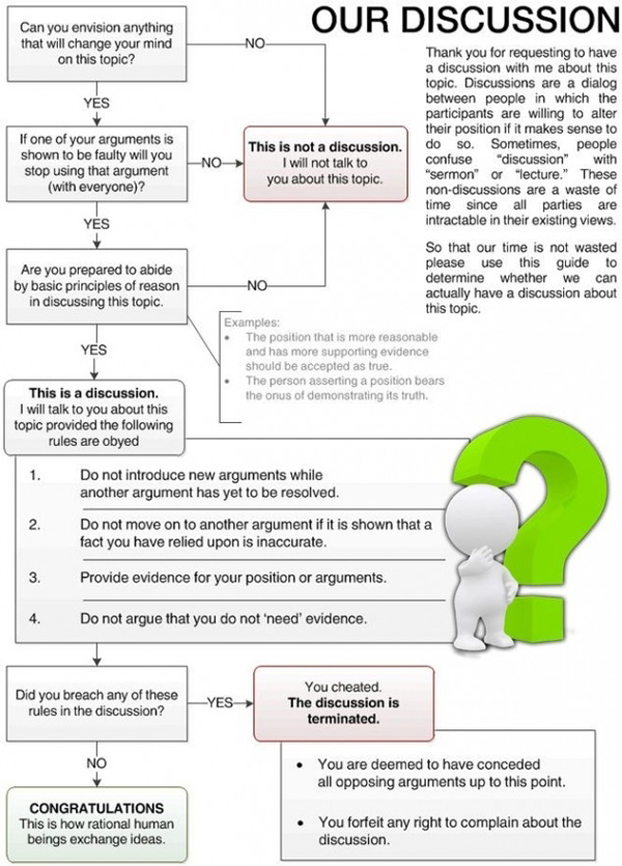
How to have a discussion

One thing I'm always wrestling with is what it means to be in right relationship-to deal with difficult issues well, to honor the different ideas, decisions, and understandings we all have, while still having a perspective and a commitment of your own.

That is why I've gotten trained in Mediation from the Kansas Institute of Peace and Conflict Resolution and in the Circle process with the Saint Louis area Restorative Justice Collaboration . It is in the spirit of restorative justice and good human relationships that I present this graphic (click to enlarge):

thought catologue
which I found today.
In particular, I think it is really important to be willing to change one's mind based on the evidence, and to listen for your own bad arguments.
I think this is a limited graphic of course-there are other kinds of conversations, that don't involve argument. We can tell stories, exchange experiences, confess, commiserate, and teach, but it is important, I think, to know the ethics of conversation, and that a debate with entrenched positions is usually useful only as public spectacle, rather than the parties involved.

Monday, March 7, 2011

perverse incentives


I learned something, and I thought I’d share it with the world.

You know how many coaches, bosses, parents, etc. think it is a good idea to yell at people to motivate them? Here's the classic angry coach clip:

This always bugs me, because I think its bad to yell at people (meanness is part of my moral calculation, even if there is room for calling people brood of vipers and white washed tombs, biblically speaking, and even if I have been known to practice a touch of sarcasm myself). 
Also, it is questionable behavior because there is some pretty good social science evidence from a number of fields that yelling doesn’t work-that praise is a better motivator. I’m most versed in the theory in regards to children, I understand it is pretty true everywhere. 
So why do so many people think yelling is good idea? Well, here is one theory: 
To summarize:
the writer, Daniel Kahneman was training flight instructors, and one defended his behavior like this:
He said, “On many occasions I have praised flight cadets for clean execution of some aerobatic maneuver, and in general when they try it again, they do worse. On the other hand, I have often screamed at cadets for bad execution, and in general they do better the next time. So please don’t tell us that reinforcement works and punishment does not, because the opposite is the case.”
Daniel thought fast:
I immediately arranged a demonstration in which each participant tossed two coins at a target behind his back, without any feedback. We measured the distances from the target and could see that those who had done best the first time had mostly deteriorated on their second try, and vice versa. 

In short: whatever you do to motivate someone, if they are performing badly, they'll likely do better next time. If they perform well, they're equally likely to perform worse next time.  Thus, with any reasonably motivated group of people, they will do better every time you yell at them, and they will do worse every time you praise them, because you praise when they succeed and yell when they fail. But if you switched your management behavior, yelling at them when they succeeded or praised them when they failed, the same phenomenon would occur in reverse.  If you actually want to improve their performance the most (not to mention be a better person) then you will use a positive reinforcement technique rather than a punitive one.

Sadly understanding of how to motivate people is so deeply ingrained that its going to be really hard to break coaches, teachers, and managers of this practice.

So, just so you know, you’re great- I’m impressed with the work you’re doing, and the way that you've improved over time, and I’m glad that you’re trying hard, even when you make mistakes.

Tuesday, March 1, 2011

What we produce

A congregant shared this article from Wired magazine with me today:
1 Million workers

it is a reflection on the Foxconn plant in Shenzhen, China, a plant that employs over a million people, is the source of many Apple products, and was in the news recently because a rash of worker suicides.

It explores factory conditions in China, and asks difficult questions-what are safe, healthy, and proper working conditions in a country with as much poverty as China? How does our consumption in the west shape the rest of the world? What does it mean to live at our resource level?

Two quotes I found particularly meaningful:
"By many accounts, those unskilled laborers who get jobs at Foxconn are the luckiest. But eyes should absolutely remain on Foxconn, the eyes of media both foreign and domestic, of government inspectors and partner companies. The work may be humane, but rampant overtime is not. We should encourage workers’ rights just as much as we champion economic development. We’ve exported our manufacturing; let’s be sure to export trade unions, too."

"To be soaked in materialism, to directly and indirectly champion it, has also brought guilt. I don’t know if I have a right to the vast quantities of materials and energy I consume in my daily life. Even if I thought I did, I know the planet cannot bear my lifestyle multiplied by 7 billion individuals. I believe this understanding is shared, if only subconsciously, by almost everyone in the Western world.
Every last trifle we touch and consume, right down to the paper on which this magazine is printed or the screen on which it’s displayed, is not only ephemeral but in a real sense irreplaceable. Every consumer good has a cost not borne out by its price but instead falsely bolstered by a vanishing resource economy. We squander millions of years’ worth of stored energy, stored life, from our planet to make not only things that are critical to our survival and comfort but also things that simply satisfy our innate primate desire to possess. It’s this guilt that we attempt to assuage with the hope that our consumerist culture is making life better—for ourselves, of course, but also in some lesser way for those who cannot afford to buy everything we purchase, consume, or own.
When that small appeasement is challenged even slightly, when that thin, taut cord that connects our consumption to the nameless millions who make our lifestyle possible snaps even for a moment, the gulf we find ourselves peering into—a yawning, endless future of emptiness on a squandered planet—becomes too much to bear."

As we reflect as a congregation what it means to live in sustainable ways, this is why we ask the question.