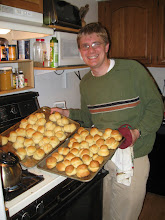
Merry Christmas to all!
This Christmas, I'm thinking about Christmas memories. In my family, most Christmas mornings, we would get up (sometimes as early as 5:30 AM, much to my parents chagrin), and run downstairs to the Christmas tree, opening stockings and presents.
Then, my family would pile into the car together, and drive the hour or so to Grandma and Grandpa Schrag's
house in Pretty Prairie, Kansas. There we would gather with family, aunts, uncles, cousins, and Great-aunt Ida for a wonderful Christmas lunch. In the afternoon, we would exchange gifts, but before that happened, we would all sit quietly while Grandmother read the Christmas story for Luke, King James version.
Thursday, December 24, 2009
Tuesday, December 22, 2009
Further thoughts on Isaiah 9
Yesterday I focused on my favorite things about the Isaiah 9 passage. But there are a couple of aspects of this passage I’d like to at least mention.
First, while this passage is about God’s gift to humanity, obviously it does not always feel like we have already received a gift from God. Which is the pattern of our lives-sometimes we are the people who are walking in darkness, sometimes we see a great light. When we find ourselves in the walking in darkness side of things, when our warriors are still trampling with their boots, and there are still garments rolled in blood, then it is harder to celebrate the hope of this passage.
Monday, December 21, 2009
Isaiah 9:2-7
This text from Isaiah 9:2-7 is one of the classic Christmas scriptures from Isaiah. His Messianic visions were always ripe for use by early Christians as they sought the Old Testament for stories that they could use to describe and understand Jesus' work in the world.
A child has been born for us, to us a son is given. My theology is often focused on how human beings ought to engage God-how we act, how we serve, how we worship, what we believe. This is because I think the most important question that human beings need to answer is ‘what shall I do’ in relationship to the world around us. Also, I usually feel like the attempt to fill the ineffable mystery of our creator with specific content is a dangerous practice, one that leads to creating God in our own image.
However, it is worth remembering that the heart of the Christmas story is not us doing things for God, but God doing things for us. A child is born for us. A son is given to us. This is at its heart a story of God at work, caring for the world, working out our salvation in partnership with humanity, with concern and tender mercy. This does not mean that we don't have to work at it-sometimes gifts can be a lot of work-take a new puppy on Christmas morning. Christmas asks us to become disciples of this child born for us, Jesus of Nazareth. But this is a story of God at work. God has broken the yoke of the oppressor, God has increased the nation’s joy, it is the zeal of the Lord of hosts that will do this, not our zeal.
Sunday, December 20, 2009
Luke 1:39-56
We had the children’s Christmas program this Sunday, so no sermon. It was my first ‘directing’ experience, and I think it went pretty well.
The gospel text for today is the Magnificat, Mary’s song of praise that she delivers after visiting her relative Elizabeth (Jesus and John are often called cousins, but there is no reason to think that Elizabeth and Mary were sisters-they are clearly very different in age).
The Magnificat is one of the most quoted texts in liberation theology-the movement started in Latin America in opposition to Dictatorships (backed by American military technology) in Central American countries. These dictators, and our relationship to them were popularized most in the Iran-Contra controversy in the Regan years, and the oppression in these countries (that does still continue) is an issue that comes up annual in protests at the School of the Americas in Fort Bennings Georgia.
Wednesday, December 16, 2009
energy use over time
This is a striking graph from CNN about energy use and CO2 output for the globe. Most interesting is noting what happens when 1/3 of the world's population gets much richer in Asia, and just how much energy North America (us) is using.
http://edition.cnn.com/SPECIALS/2009/environment/energy/
From an Advent perspective, this is 1) a reminder of how much better off billions of people are now than they were 20 years ago. That is something to celebrate! 2) The advent call is to 'turn around.' We have not slowed our use of energy or our production of CO2 much in the last 20 years. What might 'turning around' look like for us?
Sermon 12/13/09
Here is my sermon for this Sunday-hope you enjoy it.
There are two questions I'd invite conversation on in the comments 1) what do you do to inspire/practice joy in your life? How do you act to increase your joy? 2) do you have an answer to my closing question-a memory that continues to give you joy, or a plan you are particularly looking forward to this holiday season?
Isaiah tells the people “Shout aloud and sing for joy, O royal Zion, for great in your midst is the Holy One of Israel.” Isaiah always goes back and forth between the glorious future that God is preparing for the people and the dangerous moment that Israel is in currently. Here, we are at the very far end of the pendulum, being assured that we will draw water from the wells of salvation, and be able to celebrate God’s mercy, that because God is in our midst, we can celebrate, in the face of all our difficulties.
In the Philippians text, Paul invites everyone to rejoice, because they have been blessed with the Holy Spirit and the peace of Christ, because as he puts it, “God is near.” Philippians is one of the most positive of Paul’s letters, (the people of Philippi have sent him some money) and he pours love upon them, calling them “my joy and crown” and tells them “I rejoice in the Lord greatly” because of their love.
Saturday, December 12, 2009
Philippians 4:4-7
Philippians 4:4-7
Rejoice in the Lord always; again I will say, Rejoice. Let your gentleness be known to everyone. The Lord is near. Do not worry about anything, but in everything by prayer and supplication with thanksgiving let your requests be made known to God. And the peace of God, which surpasses all understanding, will guard your hearts and your minds in Christ Jesus.
This short verse from the book of Philippians is only tangentially related to Advent. The rather opaque ‘the Lord is near’ is the only real Advent connection. But the whole book of Philippians in some ways captures the Christmas spirit better (as it is most commonly understood) than many of the more dour Christmas texts about God coming in wrath.
The book of Philippians is upbeat, Paul is in a tremendous mood (he only goes on a few rants against people he disagrees with). Philippi was the first Greek city he preached in, and it was one where he had great success. The church flourished, the people of Philippi supported Paul in his mission financially, (which he appreciated) and he in return gushed about them. Paul is writing from prison in Rome, but that does not seem to dampen his spirits in the least.
Subscribe to:
Posts (Atom)