Wednesday, June 8, 2011

We have too many Guns

I am always struck by how much money we in the United States spend on our military.
One way to think about our Federal government is as an insurance program with an army (1/4 health, 1/4 social security, 1/4 military, 1/4 everything else), and that army is really really big.
How big?
This big:

Military spending
that's right. We spend more on guns than the next 17 countries combined.I think this chart is quite striking.

Imagine what else we could do with that money if we even cut 20 or 30% off of our bill.

Wednesday, March 23, 2011

How to have a discussion

One thing I'm always wrestling with is what it means to be in right relationship-to deal with difficult issues well, to honor the different ideas, decisions, and understandings we all have, while still having a perspective and a commitment of your own.

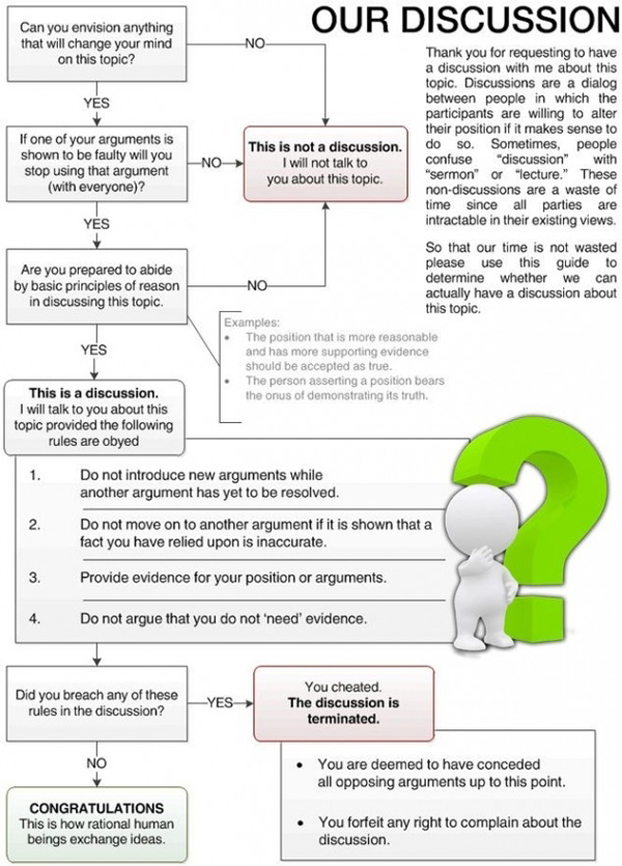
That is why I've gotten trained in Mediation from the Kansas Institute of Peace and Conflict Resolution and in the Circle process with the Saint Louis area Restorative Justice Collaboration . It is in the spirit of restorative justice and good human relationships that I present this graphic (click to enlarge):

thought catologue
which I found today.
In particular, I think it is really important to be willing to change one's mind based on the evidence, and to listen for your own bad arguments.
I think this is a limited graphic of course-there are other kinds of conversations, that don't involve argument. We can tell stories, exchange experiences, confess, commiserate, and teach, but it is important, I think, to know the ethics of conversation, and that a debate with entrenched positions is usually useful only as public spectacle, rather than the parties involved.

Monday, March 7, 2011

perverse incentives


I learned something, and I thought I’d share it with the world.

You know how many coaches, bosses, parents, etc. think it is a good idea to yell at people to motivate them? Here's the classic angry coach clip:

This always bugs me, because I think its bad to yell at people (meanness is part of my moral calculation, even if there is room for calling people brood of vipers and white washed tombs, biblically speaking, and even if I have been known to practice a touch of sarcasm myself). 
Also, it is questionable behavior because there is some pretty good social science evidence from a number of fields that yelling doesn’t work-that praise is a better motivator. I’m most versed in the theory in regards to children, I understand it is pretty true everywhere. 
So why do so many people think yelling is good idea? Well, here is one theory: 
To summarize:
the writer, Daniel Kahneman was training flight instructors, and one defended his behavior like this:
He said, “On many occasions I have praised flight cadets for clean execution of some aerobatic maneuver, and in general when they try it again, they do worse. On the other hand, I have often screamed at cadets for bad execution, and in general they do better the next time. So please don’t tell us that reinforcement works and punishment does not, because the opposite is the case.”
Daniel thought fast:
I immediately arranged a demonstration in which each participant tossed two coins at a target behind his back, without any feedback. We measured the distances from the target and could see that those who had done best the first time had mostly deteriorated on their second try, and vice versa. 

In short: whatever you do to motivate someone, if they are performing badly, they'll likely do better next time. If they perform well, they're equally likely to perform worse next time.  Thus, with any reasonably motivated group of people, they will do better every time you yell at them, and they will do worse every time you praise them, because you praise when they succeed and yell when they fail. But if you switched your management behavior, yelling at them when they succeeded or praised them when they failed, the same phenomenon would occur in reverse.  If you actually want to improve their performance the most (not to mention be a better person) then you will use a positive reinforcement technique rather than a punitive one.

Sadly understanding of how to motivate people is so deeply ingrained that its going to be really hard to break coaches, teachers, and managers of this practice.

So, just so you know, you’re great- I’m impressed with the work you’re doing, and the way that you've improved over time, and I’m glad that you’re trying hard, even when you make mistakes.

Tuesday, March 1, 2011

What we produce

A congregant shared this article from Wired magazine with me today:
1 Million workers

it is a reflection on the Foxconn plant in Shenzhen, China, a plant that employs over a million people, is the source of many Apple products, and was in the news recently because a rash of worker suicides.

It explores factory conditions in China, and asks difficult questions-what are safe, healthy, and proper working conditions in a country with as much poverty as China? How does our consumption in the west shape the rest of the world? What does it mean to live at our resource level?

Two quotes I found particularly meaningful:
"By many accounts, those unskilled laborers who get jobs at Foxconn are the luckiest. But eyes should absolutely remain on Foxconn, the eyes of media both foreign and domestic, of government inspectors and partner companies. The work may be humane, but rampant overtime is not. We should encourage workers’ rights just as much as we champion economic development. We’ve exported our manufacturing; let’s be sure to export trade unions, too."

"To be soaked in materialism, to directly and indirectly champion it, has also brought guilt. I don’t know if I have a right to the vast quantities of materials and energy I consume in my daily life. Even if I thought I did, I know the planet cannot bear my lifestyle multiplied by 7 billion individuals. I believe this understanding is shared, if only subconsciously, by almost everyone in the Western world.
Every last trifle we touch and consume, right down to the paper on which this magazine is printed or the screen on which it’s displayed, is not only ephemeral but in a real sense irreplaceable. Every consumer good has a cost not borne out by its price but instead falsely bolstered by a vanishing resource economy. We squander millions of years’ worth of stored energy, stored life, from our planet to make not only things that are critical to our survival and comfort but also things that simply satisfy our innate primate desire to possess. It’s this guilt that we attempt to assuage with the hope that our consumerist culture is making life better—for ourselves, of course, but also in some lesser way for those who cannot afford to buy everything we purchase, consume, or own.
When that small appeasement is challenged even slightly, when that thin, taut cord that connects our consumption to the nameless millions who make our lifestyle possible snaps even for a moment, the gulf we find ourselves peering into—a yawning, endless future of emptiness on a squandered planet—becomes too much to bear."

As we reflect as a congregation what it means to live in sustainable ways, this is why we ask the question.

Wednesday, February 23, 2011

Follow Up-People Power: The Game

Saint Louis on the Air had a discussion on Non-violent revolution today. It was great!
You can check it out here: http://www.kwmu.org/programs/slota/archivedetail.php?showid=4423
Their guest, Steve York, has done a lot of work on this issue, including creating an online game People Power where you can work to non-violently overthrow dictators, end human rights abuses, and other ethical practices.
I don't have time right now to buy the game ($10) and play it and see if its any good, (I may later this spring) but if any of my friends want to write a review, I'd be happy to post it here, and would love to here your thoughts!

Also, check out Gene Sharp's interview on morning edition on similar topics:
http://www.npr.org/blogs/thetwo-way/2011/02/23/133965129/gene-sharp-clausewitz-of-nonviolent-warfare-amazed-by-egypts-youth
(link from wandering road)

Tuesday, February 22, 2011

The role of the army in the Egyptian Revolution


A few more thoughts on turning the other cheek.
On Sunday, during the sermon I reflected a little on the movements going on in the Middle East, and expressed my tentative hopefulness about Egypt, Tunisia, and other countries around the Middle East becoming more democratic (in the best sense of the word-a commitment to human rights, a consensus around peace throughout society, a solid, non-corrupt judiciary and bureaucracy, and also a basically majoritarian system). I think it is great that these movements (and other ones like the Civil Rights movement, Indian Independence, the end of Apartheid, and the fall of communism) have been largely non-violent, with people really intentionally not starting an armed revolution, and thus winning peacefully significant victories for human decency and full flourishing.
From that starting point, I had some further thoughts on the question of non-violent revolutions that didn’t really fit in an already too long sermon, and I thought I’d post them here.
I think massive non-violence is clearly the best way to get rid of an autocratic government.  Over the last century, it seems pretty clear that civil war is a great way to get a lot of people killed and destroy a country, while non-violence can be the foundation for a peaceful and significant regime transition.
However, the modern revolutionary technique of mass non-violent protest is not in any way foolproof. In Iran, Thailand, and China, mass protests lead to mass killings, not social change, and the question of why some popular movements succeed and some fail is an open question. Lately I read an argument from Matt Yglesias suggesting that the success of a non-violent movement is in many ways depends on its ability to persuade the mechanisms of state sponsored violence-the police and the army-to refrain from crushing the protests. That is, it is still the people with the guns who get to make the final decision as to what happens in the country.  It seems that to a very significant extent, if the army is willing to crush dissent, that dissent will be crushed (unless you get a real civil war, obviously, where everyone loses). This reality suggests, I think, a subtle imbedded positional commandment in Jesus’ teaching to turn the other cheek (reading it from the classic Walter Winkian perspective)

That is, the lesson you could draw from modern history is those who are best armed get to make the decisions. Run with me a minute here, down the rabbit hole.
Philosopher Freidrick Nietzsche (spiritual father to the Nazi’s, and someone who I think was very wrong about a lot of things) suggested the Christianity was a religion for the poor and the downtrodden, extolling the virtues of weakness and poverty, rather than the will to power that marks true humanity.  From his perspective, the obvious lesson to learn from the modern revolutionary movement is “not non-violent resistance can transform things,” it is “if you find yourself under a dictator, join the police or the army, and you can be part of the actual power structure deciding if any possible revolution succeeds.”   Looking at it this way, non-violent resistance is useful primarily as a tool for people who have failed at the first task (getting into the military) to try and persuade those with real power to switch their allegiance. 

Now, there are obvious moral problems with this perspective, even if you’re not a pacifist-joining the armed forces of dictatorships often requires a certain amount of day to day abuse of your fellow citizens, but most people in the Egyptian army, for example, weren't really part of the direct mechanisms of oppression. But I also think this is a reminder that Jesus really did read life from the margins, from the underside, from the perspective of the poor.  Jesus looked at the Roman Empire, and it went without saying that he would not participate in polite appeasement, waiting for the optimal moment to try and seize control of Judea when the legions were elsewhere, as many of his fellow Jewish revolutionaries chose to do, but rather he refused to participate in the system, and accept the poverty, powerlessness, and danger that implied. As we honor those who risk their life in the Middle East, and reflect on our choices, I do wonder where we in the United States have positioned ourselves in our also fallen system. 

Monday, February 7, 2011

SuperBowl commercials

Like most of America, I enjoy the Superbowl and the festivities around it, even if I wonder about the violence inherent in the sport, the dangers of concussions on millions of American youth, and things of that nature.

But like many people, I'm also fascinated by the advertising binge that is the Superbowl, and the ways the companies try to market themselves. Advertising is all about image, about creating a vision of life that invites a listener to participate and become connected with a product, and so there is this process of creating a vision of what it means to be human.  Since this is a project that is near and dear to my heart, as I believe it is a fundamental part of the human task, and part of religion's role in the world, I watch with interest.

This year, in particular, I saw two massive multi-national soulless corportations offer two very different messages.
On the one hand, you have Pepsi-Max
which in this spot:
and this one:
and this one:


teach us all that Pepsi products make great weapons, that relationships between men and women are defined by the twin poles of sex and violence, that in general, life is a nasty, dog-eat-dog, uncharitable place, but hey, at least it doesn't have calories.

In contrast, Coke taught us with commercials like this one:

and this one:
that Coke products can end wars by acting as a creative non-violent method to disarm the enemy that Coke can help break down barriers between nations as a core sign of trust and respect, that all humans, all goat people, and even the ravaging horde of beast monsters are worthy of respect and their lives have value.

Obviously, I'm not going to suggest that either of these themes really speaks to the values and beliefs or practices of anyone in either company.  (To be precise, the better world shopping guide gives Pepsi a B rating and Coke a D and I think this guide is a much better way of choosing soft drinks than advertising messages). It just seems odd that Pepsi wants to communicate that people who drink their product are prone to violent rage, and that a Mennonite seems to have gotten a hold of Coke's advertising budget, and I thought it was worthy of comment, and an opportunity to encourage everyone to reflect on what stories we tell about how the world really works.

And to close, here's my favorite Superbowl commercial, on the rewards of random acts of kindness: